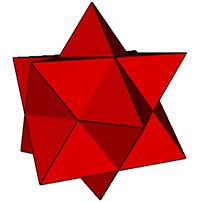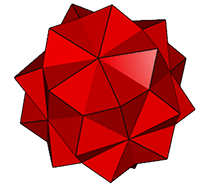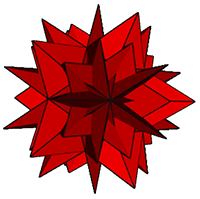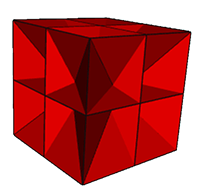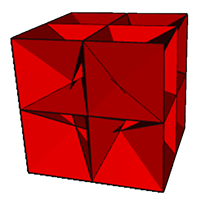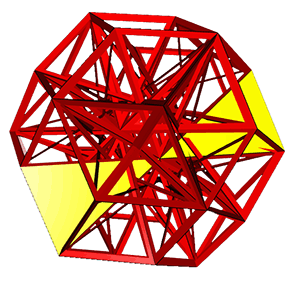
Using Great
Stella, I was in 2025 able to examine the facetings of the
Coxeter/Grunbaum isohedral rectangular polyhedra by replacing the
rectangular faces with crossed rectangles. New
polyhedra can be obtained by faceting the faces of the
rectangular
polyhedra with each rectangular polyhedron giving rise to two
crossed-rectangular
polyhedra. Using Klein's bridge method
these can be separated into two groups depending on whether the
rectangular
edges of the crossed rectangles are the edges which span acrosss the
rhombic polyhedra,
or whether they are the edges that form the rhombic faces
themselves. The first group is
described here. The second group is Type II below.
In the case
of the rhombic triacontahedron and
the great rhombic triacontahedron,
further cases can be generated by faceting.
The faces of these are unrelated to the
rectangular polyhedra or to each other.
These are
included under Type III below. Neither the Klein rectangular polyhedra nor the
duals of the ditrigonals yield any further cases
Again the crossed-rectangles can be
difficult to see in the completed polyhedron, so links
are provided below to each polyhedron with various faces
hightlighted. The crossed rectangles do not form the 'tubes' as
in the rectangular polyhedra, but do form 'loops' involving the
parallel edges of the crossed rectangles. For the diagonal
faces, they also form what I term 'rings' of faces with a common
centre.
For brevity, the term 'Crossed Rectangular' is
shortened to 'XR' in the table below. Bowers acronyms are used in
their names.

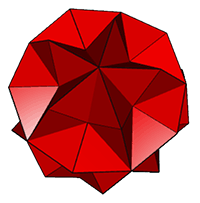
XR
rhombic
dodecahedron
One highlighted face
One highlighted loop
One highlighted ring
Seeds: Rhombic Dodecahedron
XR plus seed

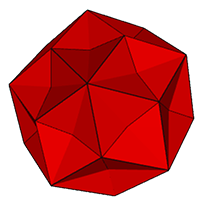
XR rhombic triacontahedron
One highlighted face
One highlighted loop
One highlighted ring
Seed: Rhombic Triacontahedron
XR plus seed

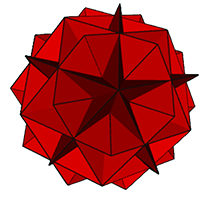
XR
great rhombic triacontahedron
One
highlighted face
One highlighted loop
One highlighted ring
Seed: Great Rhombic Triacontahedron
XR plus seed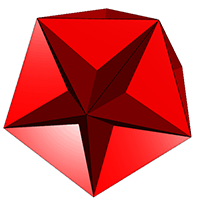
XR medial rhombic triacontahedron
One highlighted face
One highlighted loop
One highlighted ring
Seed: Medial Rhombic Triacontahedron
XR plus seed
Type
II
Bridge
facetings
between two regular
polyhedra
The rhombic polyhedra used in Type I above can also be faceted using the rectangular edges of the crossed rectangles which are the edges that form the rhombic faces to form what I term the 'crossed rectangular compliment' of the above polyhedra. Using Klein's bridge method, these can now be described as bridge polyhedra between two regular seed polyhedra.
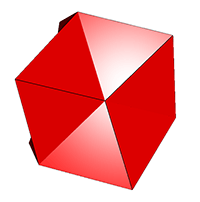
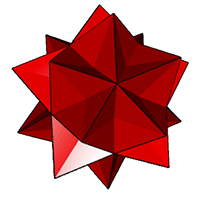
XR oct-tet
Compound
One highlighted face
One highlighted loop
One highlighted ring
Seeds: Octahedron-Tetrahedron
XR compound plus seed
Compound is XR compliment to the XR-rhombic dodecahedron
See notes below.
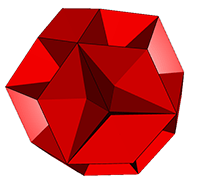
XR sissid-gissid
One highlighted face
One highlighted loop
One highlighted ring
Seeds: Small Stellated Dodecahedron-Great Stellated
Dodecahedron
XR plus seed
XR compliment
to the XR-rhombic triacontahedron
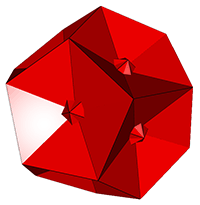
XR doe-gid
One highlighted face
One highlighted loop
One highlighted ring
Seeds: Dodecahedron-Great Dodecahedron
XR plus seed
XR compliment to the XR-great rhombic
triacontahedron

XR ike-gike
One highlighted face
One highlighted loop
One highlighted ring
Seeds: Icosahedron-Great Icosahedron
XR plus seed
XR compliment
to the XR-medial rhombic triacontahedron
Notes
on
the
XR oct-tet:
1. Generating this
polyhedron from the rhombic dodecahedron results in a
compound of two identical tetrahedral polyhedra, one of which is imaged
in the table above.
2. This polyhedron could also be classed as a Type III as only
four faces of the octahedron are connected to the tetrahedron.
With tetrahedral symmetry, the octahedron could be regarded as a
quasiregular tetratetrahedron with two distinct sets of 4 faces.
Type
III
Bridge
facetings
between
a
regular
and
quasiregular
polyhedron
Klein also extended
his bridge method to produce new examples
of the isohedral crossed rectangular
polyhedra. Klein's method involves two polyhedra with a common
centre and with faces aligned. The first polyhedron,
which I term the 'seed' (cyan in the examples below), is a regular
polyhedron, one of the Platonic
or Kepler Poinsot polyhedra. The second
polyhedron, which in this instance I term the 'shell', is a
quasiregular polyhedron
containing one set of polygons (green
in the examples below) equivalent to those in the first polyhedron.
A systematic check
was made of the possibilities: one tetrahedral, two octahedral and
twelve icosahedral. Nine additional crossed rectangular polyhedra
were obtained, one octahedral and eight icosahedral. Where the
shell is a ditrigonal polyhedron, there is always a choice as to which
is
used as each set of n-gons is in the same position in all three
polyhedra. A new naming convention is used here, where 3dit means
either of the ditrigonal polyhedra containing triangles, 5dit means either of
the ditrigonal polyhedra containing pentagons and 5/2dit means either of
the ditrigonal polyhedra containing pentagrams. (The seed-shell models
show one of the two ditrigonals.)
A systematic search was made where both 'seed' and 'shell' polyhedra were quasiregular. In this case the distinction between the two becomes arbitrary so I refer to both as shells. In addition to the octahedral case below, there are nine distinct icosahedal possibiliities in total, of which two resulted in crossed rectangular polyhedra.
|
This polyhedron has two edge connected
faces per plane, and may be considered by some to be somewhat
degenerate. |
|
|
|
|
Type V Bridge facetings between a regular polyhedron and a degenerate polyhedron.
Two octahedral
outliers were
also discovered by Klein which do not fit any of the above
categories.
|
|
See notes below. |
Notes on the XR cube2-3os2
1. The shells are a
frequency-2 cube, and three frequency-2 orthogonal squares. The
central point of the cube and the squares is not included.
2. This polyhedron has two edge connected
faces per plane, and may be considered by some to be somewhat
degenerate.
3. The two colour model above is included for clarity only and
does not signify a difference between the faces.
Crossed
Rectangular
Polyhedra
with
coplanar
faces
Two further examples can be obtained if coplanar faces sharing an edge are permitted. One stems from the the cube, with crossed-squares lie in coplanar pairs. Each square of the cube is replaced by two complimentary crossed-squares. The second stems from the the frequency-2 cube, with crossed-squares lie in coplanar sets of eight.
In the images and links below, half
of the
crossed-squares have been highlighted for clarity
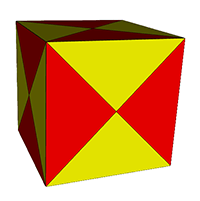 XR cube |
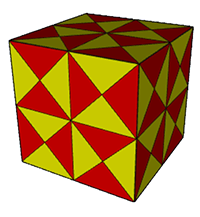 XR Frequency 2 cube |
Back to Rectangular and Crossed-Rectangular Faced Polyhedra
Back
to index