Noble
Polyhedra: Dihedral Symmetry
Hill
was able to prove that the dihedral noble polyhedra are restricted
to the disphenoids and the stephanoids (or 'crown
polyhedra').
Notes: In
all
cases one representative face has been highlighted. This face
remains solid through the various displays in the VRML
window. Pressing the 'frame' hud button will display a
'framework' version of the figure, 'hull' will then display the
figure with a framework convex hull, 'solid' returns to the initial
view.
Disphenoids
The
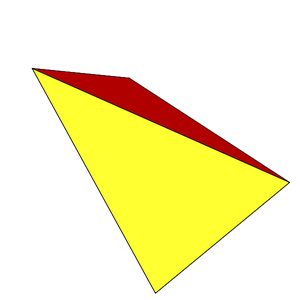
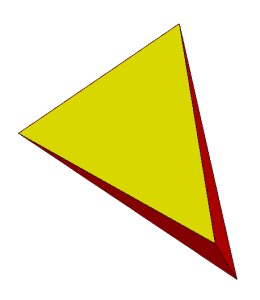
disphenoid is topologically equivalent to a tetrahedron. It
can be formed from any triangle. Examples are given below of
disphenoids formed from isosceles and scalene
triangles.
Isosceles
Disphenoid
|
Scalene
Disphenoid
|
Stephanoids
The
stephanoids can be divided into two families. They can exist
with either prismatic or antiprismatic symmetry for any value of n
> 3. For n=4 only one case exists, the antiprismatic 4-1-2. For n >
4
multiple cases exist. Examples are given below for
n=7. In
all cases they have a
degree of freedom in that they can be stretched along the n-gonal
axis while remaining noble polyhedra.
Prismatic
Stephanoids
n=7

Stephanoid 7-1-3
|

Stephanoid 7-1-5
|
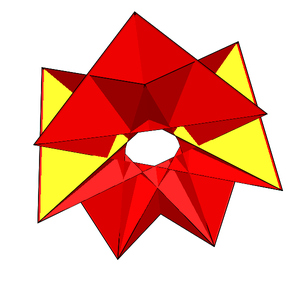
Stephanoid 7-2-4
|
|
Anti-Prismatic
Stephanoids n=7
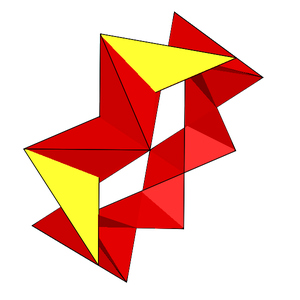
Stephanoid 7-1-2
|

Stephanoid 7-1-4
|
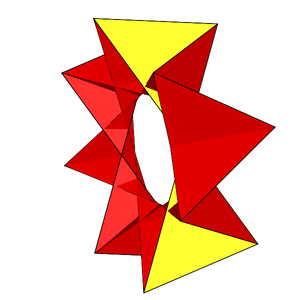
Stephanoid 7-2-3
|
|
Back:
to noble index
Back: to
main index