Noble
Polyhedra
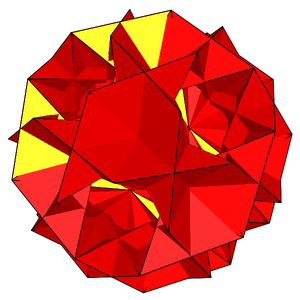
rD-4.1 |
In 2026
Connor Hill stunned the world of mathematics with his paper
"the
complete set of noble polyhedra"
[1]
in which he provides
"a
complete enumeration of the finite
polyhedra that are noble, that is, polyhedra that are vertex
transitive and facet transitive". In addition
to those
with dihedral symmetry, Hill produced a list of 146 noble
polyhedra. This paper won Hill the top $250,000 prize at the
Regeneron
Science Talent Search.
The study of
noble polyhedra, above and beyond the Platonic solids
and the Kepler-Poinsot polyhedra, began with Hess in 1875 who
discovered 16 new cases [2,3,4].
Bruckner
then
added
a further 10 cases between 1900 and 1907 [5,6,7,8].
There matters
rested until the advent of modern computer tools,
Robert Webb found a new case in 2008 [9], Ulrich
Milkloweit a further 33 in 2020 [10] and
Stella
user 'senkoquartz' a further 11 [11].
All
using Webb's Stella software [12].
Hill's discovery
not only added a significant number of cases, but
also provided a proof that the list was complete and gave a
methodology for determing the vertices of the polyhedra as
algebraic solutions to polynomial equations. I will not
atttempt to repeat Hill's arguments here as they are fully set out
in his paper.
I will though
briefly describe my own journey of discovery:
Knowing of
Hill's discoveries via the polytope wiki at
polytope.miraheze.org [13] but prior to the
publication of his
paper, I was asked 'How do you go about finding a noble polyhedron
which is not a faceting of a uniform polyhedron?' [Fn 1].
I
considered
the
following:
1.
Place
a
vertex
in
a Schwartz triangle - for the icosahedral cases (π/5, π/2,
π/3).
2.
For a noble polyhedron with a gonality of n, choose n vertices of
the polyhedron (initially at random) but eventually a systematic
search can be performed.
3.
Move the inital vertex point around in the Schwartz
triangle (also adjusting the
positions of all other vertices) until the chosen
vertices are coplanar.
4.
Form polygons from the chosen vertices (there will be a number of
closed cycles that will need to be tested)
5.
Test the resulting mesh to see if the faces form a valid
polyhedron.
If all 5 steps
can be successfuly completed, the resulting form
will be a noble polyhedron.
To implement my
ideas, I turned to Google AI Studio, and
specifically Gemini. One change to my logic was necessary
though for practical purposes
1.
Place
a
vertex
in
a Schwartz triangle - for the icosahedral cases (π/5, π/2,
π/3).
2.
For a noble polyhedron with a gonality of n, choose n vertices of
the polyhedron (initially at random) but eventually a systematic
search can be performed.
3.
Form polygons from the chosen
vertices (there
will be a number of closed cycles that will need to be
tested)
4.
Test the resulting mesh
topologically to see if the faces form a valid
polyhedron.
5.
Move the initial vertex point around in the Schwartz triangle (also
adjusting the positions of all other vertices) until the chosen
vertices are coplanar.
It was far more
efficeint to perform the 'topologic' test (the
possibility of which I had not foreseen) before the more CPU
intense coplanarity solver.
With the
assistance of
the AI I was able to produce python code that could produce all 146
of Hill's noble polyhedra.
I also generated a set of minimal symmetric injective colourings for
the complete set of noble polyhedra—a result that, to the best of my
knowledge, has not been previously documented.
My python code
is available here.
A zip
file containing OFF files for all noble polyhedra described on
these pages is available here.
A
larger zip file containing OFF, WRL, X3D and X3DV files is
available here.
I now
present all of Hill's 146 noble polyhedra. For practical
purposes I have divided them into categories mainly based on
gonality and symmetry.
References
1 Hill, Connor
"The complete set of noble polyhedra" (2026). arXiv.
https://arxiv.org/pdf/2607.28711
2.
Edmund Hess. “zwei Erweiterungen des Begriffs der
regelm¨assigen K¨orper. (German) [Two extensions to the concept of
regular bodies]”. In: der Gesellshaft zur Bedf¨ordung der gesammten
Naturwissenschaften (1875), pp. 3–26.
3. Edmund
Hess. Ueber die zugleich gleicheckigen und gleichfl¨achigen
Polyeder. (German) [About the simultaneously vertex-transitive and
face-transitive polyhedra]. zwei Erweiterungen des Begriffs der
regelm¨assigen K¨orper. Kay, 1876.
4. Edmund
Hess. “Ueber einige merkw¨urdige nicht convexe Polyeder. (German)
[About some strange nonconvex polyhedra]
5. Max Brückner. Vielecke und Vielflache:
Theorie und
Geschichte. (German) [Polygons and Polyhedra: Theory and History].
Teubner, 1900.
6. Max
Brückner. “Uber die diskontinuierlichen und nicht-konvexen
gleicheckig-gleichfl¨achigen Polyeder. ¨ (German) [On the nonconvex
and vertex-transitive, face-transitive polyhedra]”. In: Verh. des
dritten Internat. Math.-Kongresses (1905).
7. Max
Brückner. “Uber die gleicheckig-gleichfl¨achigen
diskontinuierlichen und nichtkonvexen Polyeder. ¨ (German) [On the
equal-angle, equal-surface, discontinuous, and non-convex
polyhedra]”. In: Nova Acta Leop. (1906).
8. Max
Brückner. “Zur Geschichte der Theorie der gleicheckig
gleichfl¨achigen Polyeder. (German) [On the history of the theory
of vertex-transitive face-transitive polyhedra]”. In:
Unterrichtsblatter Math. Naturwiss. (1907).
9. Robert Webb, "Noble
Faceting of Snub Cube" (2008). https://www.software3d.com/NobleSnub.php
10. Ulrich
Mikloweit.
“Exploring Noble Polyhedra With the Program Stella4D”. In: Bridges
2020 Conference Proceedings. Ed. by Carolyn Yackel et al. Vol. 25.
2020, pp. 257–264.
11. See under Discoverer at https://polytope.miraheze.org/wiki/List_of_noble_polyhedra
12. https://www.software3d.com/Stella.php
13. https://polytope.miraheze.org/wiki/List_of_noble_polyhedra
References 2-10 taken from [1] with the permission of the
author.
Footnote.
Fn 1. Thank-you Don
Romano.
Back:
to main index