Noble Polyhedra with 'Ih' (icosahedral) symmetry and 12 gonality

Notes:  In all cases one representative face has been highlighted.  This face remains solid through the various displays in the VRML window.  Pressing the 'frame' hud button will display a 'framework' version of the figure, 'hull' will then display the figure with a framework convex hull, 'solid' returns to the initial view.

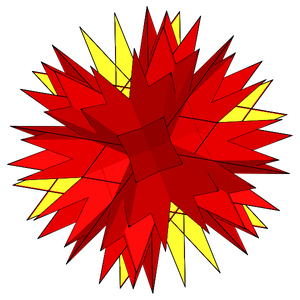
Ih-12-120-180-30-W65990-(gD-22.1)
gD-22.1
Hull: Great Rhombicosidodecahedron
Gonality / Valence: 12 / 3
V-E-F: 120-180-30
Genus / Wiener Index: 16 / 65990
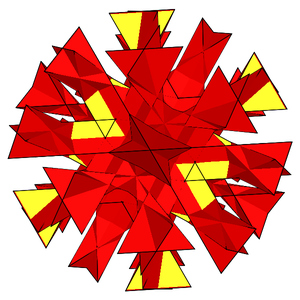
Ih-12-120-180-30-W47763-(gD-23.1)
gD-23.1
Hull: Great Rhombicosidodecahedron
Gonality / Valence: 12 / 3
V-E-F: 120-180-30
Genus / Wiener Index: 16 / 47763
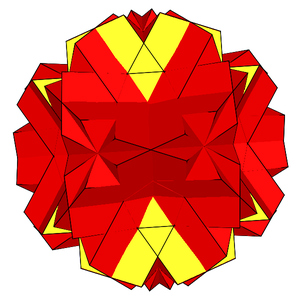
Ih-12-120-180-30-W39143-(gD-27.1)
gD-27.1
Hull: Great Rhombicosidodecahedron
Gonality / Valence: 12 / 3
V-E-F: 120-180-30
Genus / Wiener Index: 16 / 39143


Back: to noble index
Back: to main index

Footnote.

The Wiener Index is more specifically the Geometric Wiener Index, which is the sum of the shortest paths (along the edges) between any two vertices.  I find it a useful metric as apart from some duplication in the Kepler-Poinsot cases it gives a unique value for every noble polyhedron even when truncated to an integer.  In all cases the polyehdra are scaled to a radius of 1 for this calculation. The topological Wiener Index (which is the sum of the number of edges traversed) is described in wikipedia and in Wolfram Mathworld.  The 'geometric' variant used here is an extension of this using the sum of actual edge lengths.  See Mohar and Pisanski: "How to Compute the Wiener index of a Graph" https://users.fmf.uni-lj.si/mohar/Reprints/1988/BM88_JMC2_Pisanki_WienerIndex.pdf

For my generation method, examples with a gonality > 6 were not practical to generate directly as the number of ways to choose n vertices from the total became too large.  Instead, use was made of the fact that the dual of a noble polyhedron is also a noble polyhedron, so the dual of a noble polyhedron with (gonality, valence) = (m, n) would be a noble polyhedron with (gonality, valence) = (n, m).  The polyhedra above were produced as duals of noble polyheda with lower gonality.