Noble Polyhedra: Colouring Arrangements

It is an interesting exercise to investigate the possible face colouring arrangements of the noble polyhedra.  In particular I focused on 'injective' colourings, that is colourings where a particular colour cannot be present more than once at any vertex.  This also means that no two faces of the same colour can share a vertex or an edge.

I also focused on chiral octahedral and icosahedral polyhedra which have five faces meeting at each vertex, i.e., a valency of 5.  These proved to be the most interesting examples where various colouring arrangements are possible with a limited number of colours compared to some of the other examples.  There is though a repository here containing minimally coloured OFF files for all of the noble polyhedra.

For the icosahedral examples, the number of colours depends on the orbit of the vertex disjoint face cycles.  This can be tetrahedral ('T'), 5-fold prismatic ('D5'), or 3-fold prismatic ('D3').  These result in a requirement of 5, 6, or 10 colours respectively:

I-5-60-150-60-W7083-(rD-5.4)_I_5col_T
rD-5.4 (5 Colours, T)
Hull: Rhombicosidodecahedron
Gonality / Valence: 5 / 5
V-E-F: 60-150-60
Genus / Wiener Index: 16 / 7083
I-5-60-150-60-W8013-(rD-7.1)_I_6col_D5
rD-7.1 (6 Colours, D5)
Hull: Rhombicosidodecahedron
Gonality / Valence: 5 / 5
V-E-F: 60-150-60
Genus / Wiener Index: 16 / 8013
I-5-60-150-60-W7733-(rD-1.2)_I_10col_D3
rD-1.2 (10 Colours, D3)
Hull: Rhombicosidodecahedron
Gonality / Valence: 5 / 5
V-E-F: 60-150-60
Genus / Wiener Index: 16 / 7733
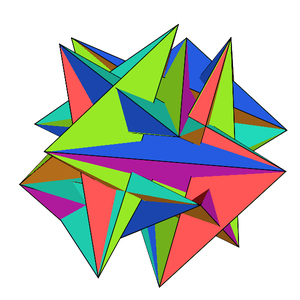
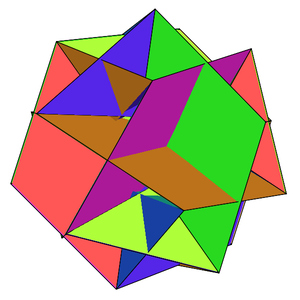
For the octahedral examples, the orbit of the vertex disjoint face cycles can be 4-fold cyclic ('C4') or 3-fold cyclic ('C3').  These result in a requirement of 6 or 8 colours respectively:

O-5-24-60-24-W806-(sC-2.1)_O_6col_C4
sC-2.1 (6 Colours, C4)
Hull: Snub Cube
Gonality / Valence: 5 / 5
V-E-F: 24-60-24
Genus / Wiener Index: 7 / 806
O-5-24-60-24-W683-(rC-1.1)_O_8col_C3
rC-1.1 (8 Colours, C3)
Hull: Rhombicuboctahedron
Gonality / Valence: 5 / 5
V-E-F: 24-60-24
Genus / Wiener Index: 7 / 683

More on the types of possible colouring arrangements and a deeper explanation of the mathematics.


Back: to nobles index
Back: to main page