
5 Colours (Subgroup T)
Type II: Tight Minimum (χi = v = 5)
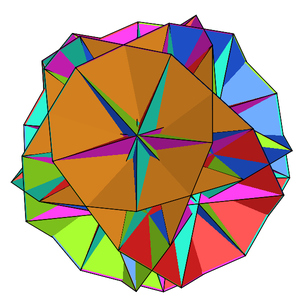
6 Colours (Subgroup D5)
Type IV: Structural Excess (5-valent, 6 colours)
Noble polyhedra are simultaneously isohedral (face-transitive) and isogonal (vertex-transitive). Because the dual of every noble polyhedron is also a noble polyhedron in the same symmetry group:
n · F = 2E = v · V
The set of possible vertex valences v in any symmetry family is identical to the set of its face gonalities n.
Under a symmetry group G, choosing an isotropy subgroup H ≤ G partitions the faces into monochromatic orbits of size |H|, yielding a palette size of:
k = F / |H|
A symmetric colouring attains the tight lower bound (χi = v) if and only if:
|
5 Colours (Subgroup T) Type II: Tight Minimum (χi = v = 5) |
6 Colours (Subgroup D5) Type IV: Structural Excess (5-valent, 6 colours) |
Noble polyhedra with chiral icosahedral symmetry (group I ≅ A5, order 60) exhibit valences v ∈ {3, 4, 5, 6, 8, 9, 12}. In the primary family with F = 60 (as well as F ∈ {12, 20, 30}), the subgroup partitions are:
| Subgroup (H) | Symmetry Type | Order (|H|) | Faces / Colour (in F = 60) | Total Colours | Theoretical & Geometric Compatibility |
| T | Chiral Tetrahedral | 12 | 12 | 5 colours | Tight Minimum for v = 5. Also serves as the minimal symmetric buffer for v = 3 and v = 4 (which lack subgroups of order 20 and 15 in A5). |
| D5 | Dihedral 5-fold | 10 | 10 | 6 colours | Realised buffer for v = 3, 4, 5. Theoretically tight for v = 6, but geometrically blocked by face collisions in realised 6-valent polyhedra. |
| D3 | Dihedral 3-fold | 6 | 6 | 10 colours | Realised buffer for v ∈ {3, 4, 5, 6, 8, 9}. Provides a valid symmetric arrangement across both primary and blocked valences. |
| C5 | Cyclic 5-fold | 5 | 5 | 12 colours | Realised buffer for v = 6, 8. Used when dihedral reflection axes intersect face boundaries. |
| D2 / V4 | Dihedral 2-fold | 4 | 4 | 15 colours | Realised buffer for high valences (v = 12). |
The full icosahedral group Ih = I × Ci has order 120, containing 15 mirror reflection planes and central inversion. Noble polyhedra in this group exhibit valences v ∈ {3, 5, 6, 12}.
Note on Th: Although Th is an abstract subgroup of order 24 (giving 5 colours arithmetically), no Ih noble polyhedron admits an injective 5-colouring under Th because reflection and inversion symmetries inevitably map faces within the same orbit into adjacent positions at shared vertices. All 5-valent Ih figures require chiral doubled palettes.
| Subgroup (H) | Symmetry Type | Order (|H|) | Faces / Colour | Total Colours | Theoretical & Geometric Compatibility |
| 2 × T | Chiral Tetrahedral Pairs | 12 | 12 (in F=120) 6 (in F=60) |
10 colours | Realised chiral doubled buffer for v = 5 and v = 6 (in F = 120 and F = 60). |
| 2 × D5 | Chiral 5-fold Dihedral Pairs | 10 | 10 (in F=120) | 12 colours | Realised structural excess for v = 5 (Chiral doubled palette). |
| 2 × D3 | Chiral 3-fold Dihedral Pairs | 6 | 6 (in F=120) | 20 colours | Realised buffer for high valences (v = 12). |
| D3 | Dihedral 3-fold | 6 | 6 (in F=60) 3 (in F=30) |
10 colours | Realised buffer for v = 3 (F=30) and v = 6 (F=60). |
| C5 | Cyclic 5-fold | 5 | 5 (in F=60) | 12 colours | Realised buffer for v = 6 (F=60). |
| D2 | Dihedral 2-fold | 4 | 2 (in F=30) | 15 colours | Realised buffer for v = 3 (F=30). |
Chiral Orbit Doubling in Ih: When a colour class is chiral (stabilizer H ≤ I), mirror reflections map each face into its enantiomorphic counterpart. Because enantiomorphic faces frequently share vertices across reflection planes, they must be assigned distinct colours, doubling the palette (e.g., 5 → 10, 6 → 12, 10 → 20).
Noble polyhedra in group O (order 24) are exclusively 5-valent (v = 5) with F = 24. Because 5 does not divide 24, a tight 5-colouring is arithmetically impossible (Type III).
| Subgroup (H) | Symmetry Type | Order (|H|) | Faces / Colour (in F = 24) | Total Colours (24 / |H|) | Theoretical & Geometric Compatibility |
| C4 | Cyclic 4-fold | 4 | 4 | 6 colours | Lowest valid symmetric buffer for v = 5 (Type III arithmetic excess). |
| C3 | Cyclic 3-fold | 3 | 3 | 8 colours | Alternative structural buffer for v = 5 (Type IV topological excess). |
The full octahedral group Oh = O × Ci has order 48. Noble polyhedra in this group exhibit valences v ∈ {3, 4, 5, 8}.
| Subgroup (H) | Symmetry Type | Order (|H|) | Faces / Colour | Total Colours | Theoretical & Geometric Compatibility |
| D4 | Dihedral 4-fold | 8 | 2 (in F=6) | 3 colours | Tight Minimum for v = 3 (Cube, F=6). |
| D3 | Dihedral 3-fold | 6 | 2 (in F=8) | 4 colours | Tight Minimum for v = 4 (Octahedron, F=8). |
| C4 | Cyclic 4-fold | 4 | 4 (in F=24) | 6 colours | Realised buffer for v = 4 (in F=24). |
| 2 × D3 | Chiral 3-fold Dihedral Pairs | 6 | 6 (in F=48) | 8 colours | Realised chiral doubled buffer for v = 5 (in F=48). |
| 2 × C4 | Chiral Cyclic 4-fold Pairs | 4 | 4 (in F=48) | 12 colours | Chiral doubled buffer for v = 5 and v = 8 (in F=48). |
The regular tetrahedron (v = 3, F = 4) is the unique noble polyhedron with tetrahedral symmetry. Under subgroup C3 (order 3), it attains an injective colouring using 4 colours.